

In the fast-paced world of construction and renovation, tile adhesives have evolved significantly from simple cement-based mortars to sophisticated chemical solutions designed for efficiency, durability, and aesthetic perfection. At the heart of many high-performance tile adheses lies Hydroxypropyl Methylcellulose (HPMC). While terms like "cementitious tile adhesive" or "thin-set mortar" grab attention, understanding the role of key additives is crucial for professionals seeking optimal results.
This blog post delves deep into HPMC in tile adhesive – its purpose, benefits, how it compares to alternatives, and why it has become such a vital component. We aim to provide you with valuable, experienced insights into maximizing adhesion performance through this remarkable ingredient.
1. What is the Tile Adhesive?
Tile adhesives are compounds used to stick tiles to walls or floors firmly. Fortunately, the application of our MelaColl HPMC in tile adhesive can improve all the features of tile adhesive to satisfy all demands in construction. Therefore, tile adhesive is expected to fix the tiles not just for several years but for decades without failure. It must be easy to use and should not have any gaps between the tile and the substrate.
2. What is Hydroxypropyl Methylcellulose (HPMC)?
First things first: HPMC isn't the adhesive itself; it's an additive – specifically known as S-1 or A-1 in many tile adhesive formulations. Chemically, HPMC is a semi-synthetic polymer derived from cellulose, modified by reacting methyl and hydroxypropyl groups.
Think of it like this:
- Natural Component: Cellulose (found in plant cell walls).
- Semi-Synthesis: The modification alters the natural properties for specific industrial applications.
- Function: It primarily acts as a viscosity modifier, water retainer or film former assistant, and sometimes provides bulking/sanding resistance control.
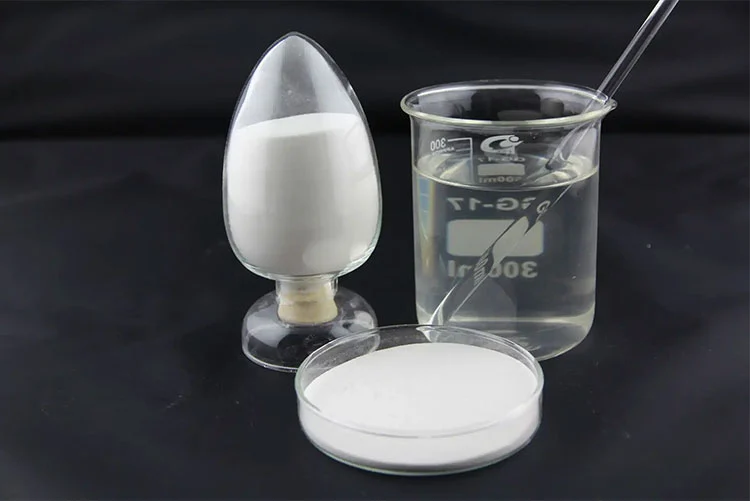
It's not to be confused with Cellulose Gum (a derivative often called A-4, used in some adhesives for different properties) but is closely related. Its modified nature gives it unique solubility characteristics – crucial for our discussion!
Hydroxypropyl methyl cellulose(HPMC) or hypromellose is a water-soluble non-ionic cellulose ether polymer. The chemical properties can vary according to the degree of substitution and modification. With good performance of thickening, dispersion, emulsification, suspension, adsorption, surface activity, and water retention, our HPMC products are widely used in tile adhesives.
3. Why use HPMC in tile adhesives?
Tile adhesive performance hinges on several factors: good mixing consistency, excellent workability (open time), strong initial and ultimate bond strength, high adhesion to various substrates (including hydrophobic surfaces like porcelain), volume shrinkage control, crack resistance, and ease of tiling. HPMC plays a pivotal role in achieving or enhancing most of these:
3.1 Effect to the open time
What it does: HPMC thickens the adhesive just enough to prevent sagging under heavy tiles (especially large format ones) but doesn't make it too stiff for easy spreading.
Why it's important: More time allows you and your team to place, align, and adjust tiles without worrying about the mortar setting prematurely. This is critical for intricate installations or busy workdays.
In a wet mortar, the water in the mortar will evaporate, and then cellulose ether will be gathered on the surface. A film will form on the mortar surface within 5 minutes, which will reduce the subsequent evaporation rate. Therefore, hydroxypropyl methyl cellulose (HPMC) can extend the opening hours.
3.2 Enhanced Consistency / Bulking Resistance:
What it does: As aggregates (sand) are added, they absorb water and swell slightly – a phenomenon called bulking.
Why HPMC helps: Its fibrous structure provides resistance to this swelling, ensuring the product has stable volume even when fully saturated with water. This prevents overestimation of material quantity during mixing.
3.3 Superior Water Retention:
What it does: This is perhaps its most crucial role. HPMC swells dramatically in water (forming a hydrogel), retaining significantly more moisture than standard additives.
Why it's important: Adequate moisture is vital for the chemical reaction of cement-based adhesives ("hydration") and also helps transport binders deep into porous substrates like concrete or plasterboard. Without sufficient water retention, adhesion can be compromised.
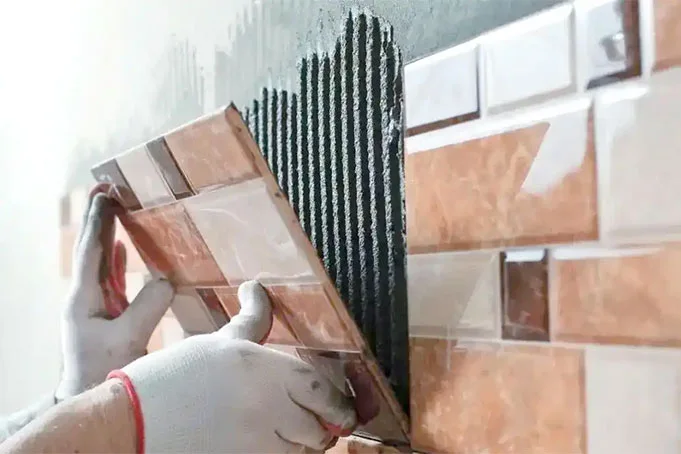
3.4 Effect to the pull strength
- What it does: By improving workability, ensuring thorough substrate penetration (especially in coarse aggregates), and optimizing hydration, HPMC contributes indirectly to higher ultimate bond strength.
- Why it helps: It ensures the adhesive fully saturizes the substrate surface fibers before setting excessively rigid. This leads to a stronger, more cohesive bond.
HPMC can also delay the hydration kinetics of cement. This retardation is mainly due to the absorption of HPMC molecules by various mineral phases in the hydrated cement system. Specifically, HPMC molecules are mainly adsorbed on hydration products, such as C-S-H and calcium hydroxide. Besides, due to the increase in the viscosity of pore solutions, HPMC reduces the mobility of ions (Ca2+, SO42-, …) in the pore solution, thereby further delaying the hydration process. Therefore, HPMC in tile adhesive can extend the tensile strength of tile adhesives.
3.5 Improved Adhesion to Difficult Substrates (Hydrophobic):
What it does: HPMC's ability to swell and retain water is key for adhering well to hydrophobic surfaces like glazed ceramics, porcelain tiles, or absorbent plastics.
Why: High cement content adhesives can suffer from rapid dehydration on slick surfaces. The swelling action of HPMC hydrates the surface effectively even if it's initially dry-repellent (hydrophobic), creating a strong bond.
3.6 Reduced Shrinkage Cracking & Enhanced Flexibility:
What it does: HPMCs have some inherent elasticity and can absorb stresses or strains.
- Why it helps: By retarding water evaporation, they allow the cement matrix to hydrate fully and cure properly. This results in a stronger, less brittle adhesive that shrinks less during drying compared to formulations without adequate viscosity control, reducing crack formation.
The primary function of HPMC in tile adhesives is water-retaining and thickening. The purpose is to increase the final solidification strength of the tile adhesive, extend the open time, and improve its workability. Usually, when we evaluate the performance of tile adhesive, in addition to its workability and anti-sliding ability, we also pay attention to its mechanical strength and open time.
4. HPMC vs. Other Common Tile Adhesive Thickeners/Additives
Many tile adhesives use cellulose ethers for thickening. The most common are Microfibrillated Cellulose(MFC) and Hydroxyethyl Cellulose (HEC).
HPMC:
Strengths: Excellent water retention, good bulking resistance even in high sand concentrations, superior film formation properties, often better adhesion to hydrophobic surfaces than MFC/HEC. It's highly effective at providing body/solids content.
- Weaknesses: Slightly more expensive than basic HEC or MFC (though value is added). Requires careful handling due to its powder form and potential dusting.
Microfibrillated Cellulose (MFC):
- Strengths: Primarily used for increasing viscosity. Good performance in many situations.
- Weaknesses: Typically has very poor water retention compared to HPMC, making it less ideal for high-performance adhesives on difficult substrates or large tiles.
Hydroxyethyl Cellulose (HEC):
- Strengths: Excellent viscosity builder and provides good water retention. Often used as a co-additive with HPMC in some formulations.
- Weaknesses: While effective, it may not provide the same level of elasticity or film-forming capability for adhesion assurance on hydrophobic surfaces compared to pure HPMC.
(Competition Note: Acknowledge these alternatives but clearly explain how HPMC differentiates itself, particularly in high-performance applications. This adds Authority and provides value.)
5. Choosing the Right HPMC Grade
Not all tile adhesives are created equal, nor is one standard "HPMC" suitable for every application. The specific grade or type of HPMC used significantly impacts performance:
Typical Grades:
High Viscosity (50cps): Often preferred for thick-bed applications where excellent volume stability and strong adhesion are paramount, especially with heavy tiles.
Medium/Standard Viscosity: Suitable for most general-purpose floor and wall tiling. A common benchmark is HPMC with a viscosity around 200-300 cP (centipoise) at shear thinning – the classic choice found in many reputable S-1 adhesives.
- Low Viscosity Options: Sometimes used for specific purposes like crack bridges or very specialized formulations, but less common overall.
- Experience Tip: The "Standard" viscosity HPMC is often a safe starting point. It's widely available from various manufacturers (including competitors!). However, the best adhesive formulation requires high-quality raw materials – and that includes using the right grade of S-1/HPMC for the specific product requirements.
View More Melacoll™ HPMC GRADE
6. MIKEM Product Recommended for Tile Adhesive
6.1 MelaColl™ HPMC in Tile Adhesive
Tile adhesives are one of the most extensive applications of our MelaColl HPMC products. We provide economical, standard, and premium grades of products for tile adhesives. These different grades of products contain different amounts of MC and therefore, providing differing properties (for example, open time, sag resistance).
6.2 Improved Features of Tile Adhesive by MelaColl HPMC products
 Melacoll HPMC effectively locks moisture within the adhesive paste layer through its superior water retention properties, ensuring complete cement hydration and significantly enhancing bond strength. Simultaneously, it extends the working time, providing construction personnel with greater flexibility for adjustments. As an efficient thickener, HPMC imparts the tile adhesive with optimal viscosity, enabling easy troweling and uniform application while effectively preventing slippage and sagging.
 Melacoll HPMC effectively locks moisture within the adhesive paste layer through its superior water retention properties, ensuring complete cement hydration and significantly enhancing bond strength. Simultaneously, it extends the working time, providing construction personnel with greater flexibility for adjustments. As an efficient thickener, HPMC imparts the tile adhesive with optimal viscosity, enabling easy troweling and uniform application while effectively preventing slippage and sagging.
| Application Scenarios | Key Contributions of HPMC |
| Thin-layer tile adhesive(C1/C2) | Precisely control viscosity to ensure a thin, even layer free of bubbles. |
| Thick-layer application method | High water retention prevents rapid moisture loss, ensuring thorough curing of thick layers. |
| Underfloor heating system | Resists heat aging and retains moisture, adapts to temperature fluctuations |
| humid environment | Adjusting the open time to accommodate high-humidity curing conditions |
- Want highly matched HPMC product for your adhesive tile project? Just contact us for more information about products or a sample! MIKEM are always ready to answer any of your question with one-to-one service and customized products solution!

7. Impact on Installation Quality
The benefits of good HPMC aren't just theoretical; they directly translate to better installation outcomes:
- Reduced Labor: Longer open time means fewer rush jobs, less tile sliding, easier mixing and placement.
- Better Bonding: Improved adhesion ensures the tiles stay firmly in place over time, resisting slip-outs or loosening due to substrate deflection or drying shrinkage.
- Enhanced Durability: Adhesives with controlled shrinkage are less prone to cracking, leading to more durable installations that won't develop hairline cracks compromising the tile layer.
8. The Future is Firm: Trends in Tile Adhesive Technology
The demand for higher performance and versatility in tiling systems continues. This drives innovation, particularly in additives like HPMC:
- Increased Use of HPMCs: More manufacturers are shifting away from basic MFC/HEC towards formulations where high-quality S-1/HPMC is the primary thickening and water-retaining agent because it delivers superior performance.
- Specialized Grades: Development of new polymer types or modification levels allows for even better control over open time, adhesion, shrinkage reduction, etc., tailored to specific tile types (ceramic, porcelain) or substrates.
Conclusion
Hydroxypropyl Methylcellulose (HPMC/S-1) is a game-changer in the world of modern tile adhesive. It's not just an additive; it's the intelligent viscosity control mechanism that ensures water stays where it needs to for optimal hydration, substrate penetration, and adhesion development on even challenging surfaces.
For professionals choosing tile adhesives or formulating their own products, understanding HPMC is no longer optional – it's essential. The right grade of high-quality S-1/HPMC contributes significantly to the adhesive's performance profile: from ensuring smooth application and sufficient working time to ultimately delivering a long-lasting, crack-resistant bond.
When evaluating tile adhesive options, ask about "S-1" or look for reliable sources discussing HPMC – you're likely dealing with products designed by experienced formulators aiming for high quality. Don't underestimate the power of this polymer in achieving truly superior tiling results!

Posted by Melacollleave words
Hi, I'm Ella, I have been engaged in the cellulose ether industry for 12 years.

Leave a Reply