
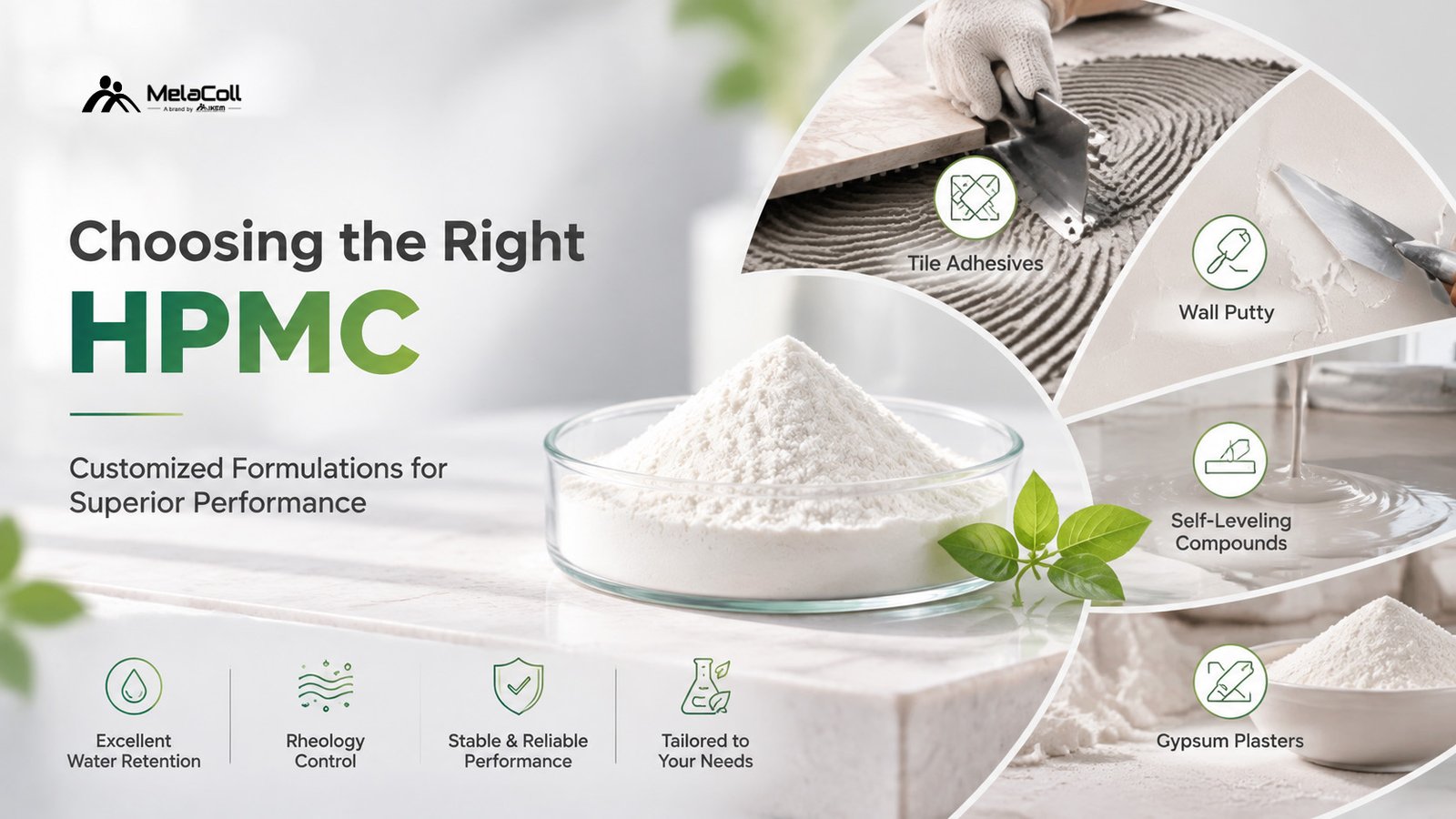
Hydroxypropyl Methylcellulose (HPMC), also known as hypromellose, is a highly versatile, non-ionic cellulose ether derived from natural high-polymer cellulose. Through precise chemical etherification, it is transformed into an odorless, white to off-white powder that acts as a fundamental additive across various industries.
As a leading HPMC manufacturer and solutions provider, Melacoll specializes in delivering customized formulation solutions designed to achieve exceptional water retention, thickening, and rheology control. This guide explores the core properties of HPMC and how to select the precise formulation for your specific construction and industrial applications.
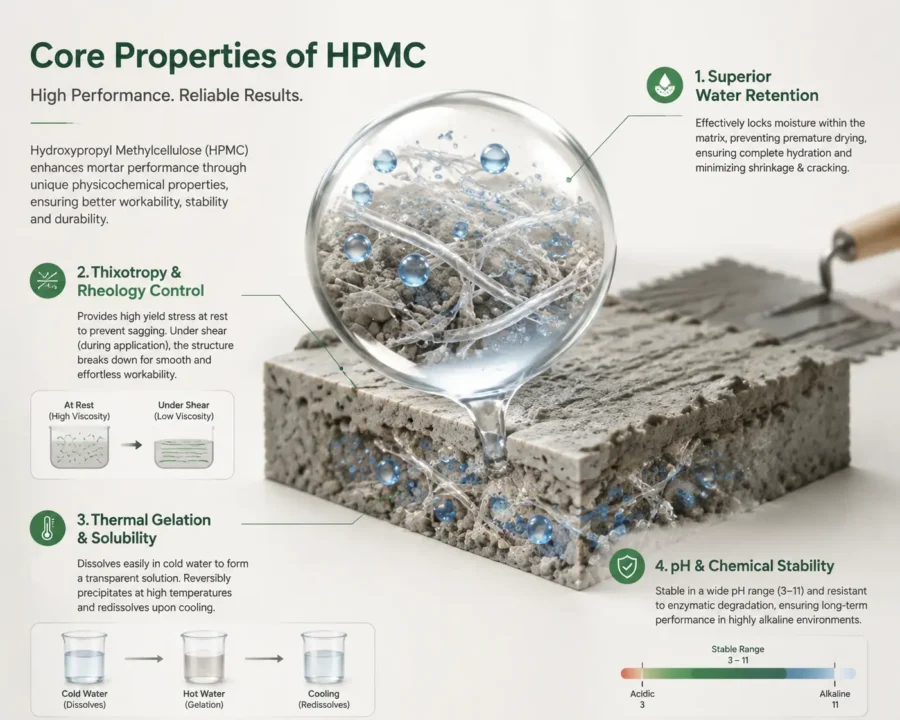
Core Properties of High-Performance HPMC
The performance of HPMC in dry mix mortars and industrial applications relies on its unique physicochemical properties. When integrating HPMC into your products, these are the primary characteristics at play:
- Superior Water Retention: HPMC effectively locks moisture within the matrix of building materials. This prevents premature drying, ensures complete cement hydration, and minimizes shrinkage and cracking.
- Thixotropy and Rheology Control: HPMC imparts a critical shear-thinning behavior to mortar. At rest, it provides high yield stress to prevent sagging (static state). Under shear (during troweling), the structure breaks down temporarily, ensuring smooth workability and effortless application.
- Thermal Gelation & Solubility: HPMC dissolves readily in cold water to form a transparent colloidal solution. It exhibits reversible thermal gelation—precipitating out of solution upon heating and redissolving upon cooling.
- pH and Chemical Stability: HPMC remains remarkably stable across a broad pH range (3–11) and exhibits high resistance to enzymatic degradation, ensuring long-term performance in highly alkaline cementitious environments.
Essential Applications of HPMC in Construction
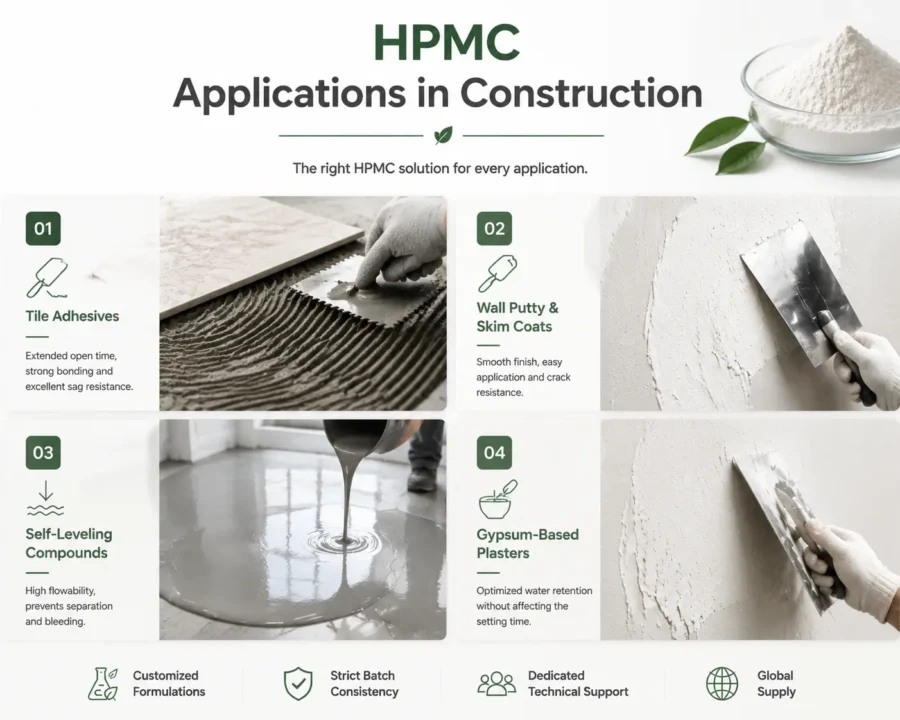
HPMC is an indispensable component in modern dry-mixed mortar systems. Depending on the binder used—whether cement-based or gypsum-based—tailored HPMC formulations act as performance enhancers in the following applications:
1. Tile Adhesives
In tile adhesive formulations, HPMC is crucial for extending open time and improving bonding strength. It ensures that moisture is retained long enough for the adhesive to cure properly while providing excellent sag resistance, preventing heavy tiles from slipping on vertical surfaces.
2. Wall Putty and Skim Coats
For wall putties, HPMC acts primarily as a water-retaining and thickening agent. It ensures the putty remains workable, provides a smooth finish, and prevents cracking or powdering after the wall dries.
3. Self-Leveling Compounds
Self-leveling systems require extreme fluidity. Specialized low-viscosity HPMC formulations are used to prevent cement separation and bleeding, maintaining a homogenous mixture without compromising the compound's flowability.
4. Gypsum-Based Plasters
Gypsum systems have unique water demand profiles. HPMC grades with specific substitution degrees are utilized to optimize water retention without excessively retarding the natural setting time of the gypsum.
Technical Deep Dive: Customizing Your HPMC Formulation
Beyond standard applications, the underlying chemistry of your HPMC dictates its on-site performance. Achieving the perfect result requires customizing two critical factors: the MS/DS ratio and the viscosity.
The Chemistry: MS vs. DS
The fundamental performance of HPMC is governed by its Degree of Substitution (DS) and Molar Substitution (MS):
- DS (Methoxy Substitution): Represents the average number of hydroxyl groups replaced by a methoxy group. A higher DS typically increases the thermal gelation temperature.
- MS (Hydroxypropoxy Substitution): Represents the hydroxypropyl groups attached. Higher MS values generally yield better hydrophilicity and superior water retention, which is essential for maintaining open time in hot climates.
At Melacoll, our R&D experts adjust these MS/DS ratios to create customized formulations that behave predictably and optimally in your specific binder systems.
Viscosity Selection Guide
Choosing the correct viscosity (measured in a 2% aqueous solution at 20°C) is arguably the most critical step in HPMC selection. Applying the wrong viscosity can lead to formulation failure.
| Viscosity Range | Typical Grade | Ideal Applications | Primary Function |
|---|---|---|---|
| Low Viscosity | ≤10,000 mPa·s | Self-leveling compounds, highly fluid grouts | Prevents separation, maintains high fluidity. |
| Medium Viscosity | 10,000 – 40,000 mPa·s | Wall putty, skim coats, standard plasters | Balances workability, finish, and water retention. |
| High Viscosity | ≥40,000 mPa·s | Tile adhesives, EIFS/ETICS, thick-layer mortars | Maximizes sag resistance, prevents tile slip, high water retention. |
Industrial and PVC Applications
Beyond construction, Melacoll’s high-performance HPMC acts as a vital dispersing agent and protective colloid in the suspension polymerization of PVC. It controls resin morphology, promotes a uniform particle size distribution, and significantly improves plasticizer absorption during downstream processing.
Why Choose Melacoll as Your HPMC Formulation Partner?
Melacoll is a specialized manufacturer and global supplier focused strictly on delivering customized cellulose ether formulations. We understand that every project, climate, and application has unique demands, which is why standard off-the-shelf products often fall short.
- Tailored Formulations: Our technical team works closely with you to design custom HPMC formulations, adjusting viscosity, water retention, and slip resistance to match your exact product requirements.
- Strict Batch Consistency: Advanced automated etherification ensures every custom batch meets exact specifications, providing reliable performance every time.
- Dedicated Technical Support: From lab testing to on-site application, we provide end-to-end support to ensure your formulations succeed in the market.
Ready to optimize your product formulations?
Ensuring the right HPMC solution is the first step to a successful product. Contact the Melacoll team today to discuss your specific requirements, request a tailored Technical Data Sheet (TDS), or get a competitive quotation based on your customized formulation.
Contact Melacoll today for customized HPMC solutions that deliver uncompromising performance.
Frequently Asked Questions (FAQ)
Q1: What is the primary role of HPMC in tile adhesives?
A: HPMC drastically improves water retention, extends open time, enhances bonding strength, and provides the necessary thixotropy to prevent vertical tile slipping.
Q2: How does temperature affect HPMC solubility?
A: HPMC readily dissolves in cold water. In hot water, it exhibits a phenomenon called reversible thermal gelation, where it precipitates out at high temperatures and redissolves as it cools.
Q3: Can Melacoll create a specific HPMC formulation for my unique mortar?
A: Yes. Melacoll specializes in customized formulations. We can adjust the degree of substitution, viscosity, and specific rheological properties to perfectly match your binder system and local climate conditions.

Posted by Melacollleave words
Hi, I'm Ella, I have been engaged in the cellulose ether industry for 12 years.

Leave a Reply