
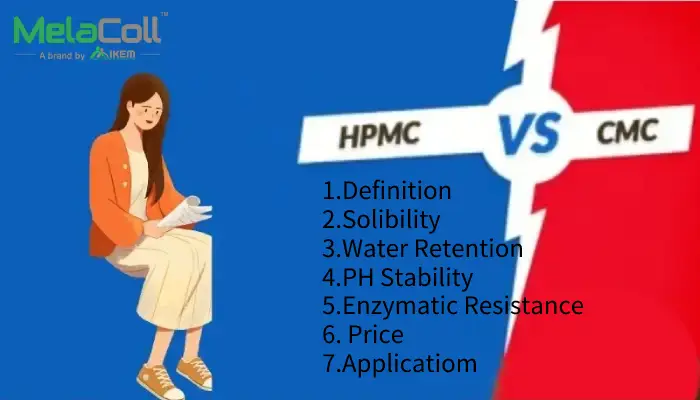
If you don't distinguish HPMC and CMC, there are 7 differences you need to know. HPMC vs CMC: their differences mainly focus on Definition, Solubility, Water Retention, Ph Stability, Enzymatic Resistance, Price and Application.
No.1 HPMC VS CMC: different definition
HPMC is prepared by reacting alkali cellulose with chloromethane and propylene oxide. This process mainly take place on etherification of workshop. Carboxymethyl cellulose (CMC) is a cellulose derivative formed by the reaction of alkali and chloroacetic acid.

N0.2 different solubility
HPMC dissolves easily in cold water and may be difficult to dissolve in hot water. But CMC is easy to dissolve in hot and cold water, and the solubility of HPMC in cold water is higher than CMC.

No.3 different water retention
HPMC has better water retention than CMC. This is their big difference.
No.4 different PH stability
Melacoll™ HPMC remains stable in the range of pH 3~11. However, PH has a great effect on CMC, it is mainly used in gypsum rather than cement.
In a strongly alkaline environment, CMC’s viscosity will be lost. But HPMC will speed up its dissolution rate and increase its viscosity.
1.HPMC aqueous solutions exhibit exceptional stability, unaffected by pH levels, maintaining stability in acidic, neutral, and alkaline environments. Solubility increases as viscosity decreases. The gelation temperature for products of different specifications ranges between 50-90°C. Exceeding the gelation temperature will cause precipitation to form.
2.CMC-Na exhibits strong hygroscopicity and readily dissolves in water to form a high-viscosity colloidal solution, though its properties are significantly influenced by pH and temperature: it remains stable in neutral and alkaline environments, but prolonged heating above 80°C causes viscosity reduction. It is insoluble in acids and alcohols; exposure to strong acids precipitates free acid, while salts do not cause precipitation but may affect viscosity stability. Its water solubility depends on the degree of substitution. Higher substitution yields better water solubility. Industrial products typically have a substitution degree between 0.4 and 1.2.
No.5 different enzymatic resistance
HPMC has better resistance to enzymes than CMC, so HPMC solution is less easily degraded by enzymes.
No.6 different price
HPMC price is evidently higher than CMC.
No.7 different application
1. Core Application Areas of HPMC
The construction industry represents the largest application scenario for HPMC. As a water-retention agent, retarder, and binder in cement mortar, putty powder, and tile adhesives, it significantly enhances the plasticity of slurries, extends working time, reduces cement consumption, and prevents cracking after hardening. Additionally, in the pharmaceutical industry, it functions as a tablet binder, coating material, and artificial tear base (with osmotic pressure close to tears, minimizing irritation). In the food industry, it is used for preserving fruits and vegetables and thickening frozen food products. In the coatings, ceramics, and textile industries, it serves as a thickener, dispersant, and stabilizer.
2. Core Application Areas of CMC-Na
CMC-Na demonstrates particularly prominent applications in the food industry. As a thickener and emulsion stabilizer in acidic milk beverages, yogurt, bread, jellies, and similar products, it stabilizes proteins, prevents fat separation, enhances texture, and extends shelf life. In petroleum drilling, it functions as a drilling mud treatment agent to regulate mud viscosity and prevent wellbore collapse. In the daily chemical industry, it is used in detergents and toothpaste to enhance system viscosity and stability. In papermaking, leather processing, and water treatment, it serves as a sizing agent and flocculant.
This is 7 difference between HPMC and CMC. However, whatever any products, their impact is important. If you want to know HPMC and MHEC difference, please click here.
Summary
The core difference between HPMC and CMC stems from their ionic properties: HPMC is nonionic, offering excellent pH stability and film-forming capabilities, and is primarily used in construction and pharmaceutical applications. CMC-Na is anionic, featuring strong emulsifying power and moderate cost, and is predominantly applied in food processing and petroleum drilling. In practical applications, the appropriate product should be selected based on the system's pH, temperature, and functional requirements. Performance can also be optimized through blending.

Posted by Melacollleave words
Hi, I'm Ella, I have been engaged in the cellulose ether industry for 12 years.

Leave a Reply